
Ask someone what they actually remember about a Jewish wedding they attended, and centerpieces almost never come up. Turns out there’s real data behind that, 81% of guests say the entertainment (dancing, music) is what actually stays with them long after the day itself, ahead of the food, ahead of the flowers, ahead of nearly everything else. That’s a lot resting on whoever’s running the booth.
And a dance floor that stays full from the Hora through the very last song isn’t something that just happens or somehow someone got lucky. It’s because someone planned for it. They understood the traditions running through the day, read the room as it happened, and kept adjusting as the night unfolded.
That’s really what separates a professional DJ from someone with a good speaker system and a big song library. It’s not about queuing songs in the right order. Instead, there’s a secret behind creating a memorable wedding night and that takes a completely different set of instincts. Here’s what that secret looks like once you break it down.
Why a Packed Dance Floor Defines an Unforgettable Jewish Wedding
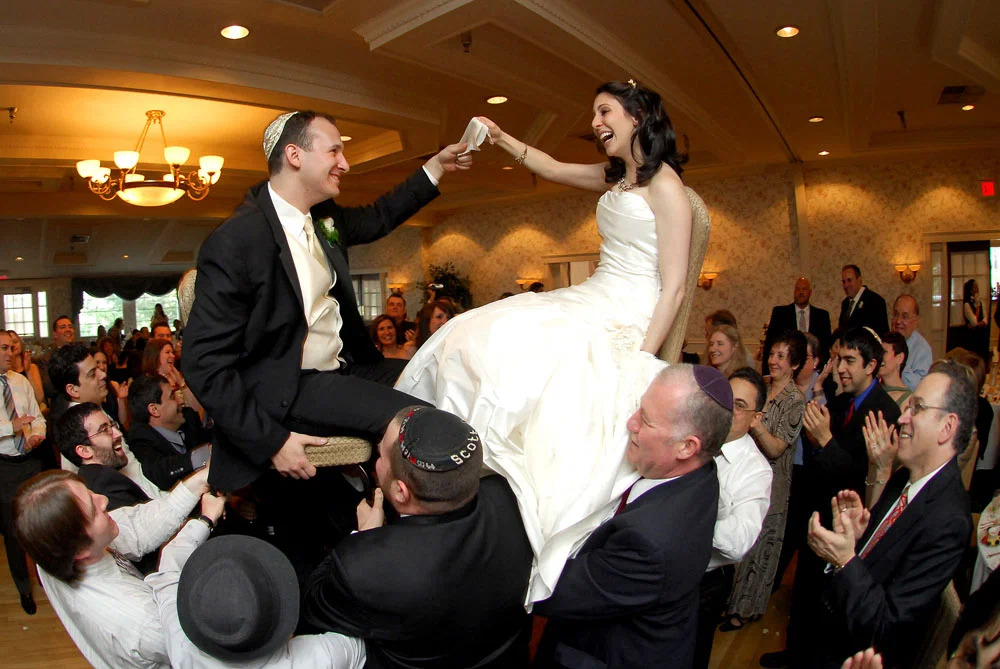
Walk into the reception right as the Hora starts and you’ll feel the shift immediately, chairs lifting into the air, guests cheering, everyone on their feet at once. That’s not spontaneous excitement showing up out of nowhere. It’s part of the tradition itself.
The harder thing to explain, and maybe the more interesting one, is why it hits everyone differently. A grandmother getting lifted in her chair isn’t experiencing the same thing her twenty-two-year-old grandchild is, watching from a few feet away, one’s wrapped up in decades of family history, the other’s just having the time of her life. Two very different experiences, one shared dance floor.
You’ve almost never seen this happening at other weddings or parties, right? It’s a big reason people leave a Jewish wedding remembering the dance floor above almost anything else, sometimes even before the ceremony or the vows.
Great Jewish Wedding DJs Start Long Before the Wedding Day
None of this starts on the wedding day itself. The real work happens weeks, sometimes months earlier, in conversations most guests never see or think about. A DJ has to actually get to know the couple, not just pull a list of favorite songs, he has to understand what kind of energy they want the whole night to carry.
That prep work stretches into the family’s specific traditions too. Ashkenazi and Sephardic customs differ in real ways, and even families within the same tradition tend to have their own version of things. Then there’s the timeline itself, dinner, speeches, candle lighting, the Hora, open dancing. All need to be mapped out in advance so nothing feels rushed or thrown together. It’s telling that 78% of brides said, looking back, they wished entertainment had been their top planning priority too.
The Hora Creates the First Major Energy Peak
Calling the Hora “a fun dance” undersells what’s actually happening. It’s the moment the couple gets physically lifted by the people who love them most, and it’s arguably the single most emotionally loaded few minutes of the entire day. Rush it and it feels flat, whereas, time it right and it’s the thing guests bring up at dinners for years.
There’s actual psychology behind why that timing matters so much. Researchers Daniel Kahneman and Barbara Fredrickson found that people remember experiences almost entirely based on their most intense moment and how they ended, not the average of everything in between. The Hora is exactly that kind of peak, which is why a skilled DJ builds anticipation deliberately in the minutes before it, rather than announcing it cold and makes sure the energy carries smoothly into open dancing afterward instead of letting the room’s energy flatten out.
Crowd Reading Is the Secret Behind a Full Dance Floor
Every wedding crowd is genuinely different, and no pre-built playlist survives for very long. A set list is really just a starting point, a rough sketch built weeks in advance before anyone knows how a mix of guests will actually respond on the night.
What happens after that first song plays is where the real skill shows up. Reading the crowd, constantly and without a break, is what separates a DJ who keeps a floor genuinely full from one who’s just running through songs in a reasonable order. That skill breaks down into a few specific habits:
1. Watching Guest Reactions
A skilled DJ is constantly scanning the room, noticing who’s dancing, who’s hesitating near the edge of the floor, and who’s already drifting back toward their seat.
2. Adjusting Music in Real Time
The set changes based on what’s actually landing in that exact moment, not what looked good on paper during a planning call three weeks earlier.
3. Knowing When to Change Tempo
It’s important to catch the dip in energy before it fully crashes on the dance floor, then DJ should know how to rebuild it back up.
4. Keeping Different Generations Engaged
Genres get blended on purpose so a grandmother and a college-age cousin both find a reason to get up. This has become a real priority for couples too, one recent industry survey found that keeping guests of every age genuinely engaged now ranks among the top qualities couples look for in a wedding DJ.
How Music Flow Keeps the Celebration Moving
A great set doesn’t hit peak energy in the first twenty minutes and stay there, it moves in waves. Energy needs to build gradually, or the room burns out long before the night’s actually over. Most wedding entertainment specialists agree that open dancing peaks best around the 90-minute mark, with two hours as the practical ceiling for most crowds before energy naturally starts to fade.
Peak moments like the ones around the Hora, a favorite song, or even a surprise request, matter more when spaced out instead of stacked together. Guests also need real room to recharge, a slower song, a breather between high-energy stretches, before the next push them back onto the floor.
And the ending matters just as much as the opening. A night that fades out quietly leaves a different impression than one that closes with real impact, which is why the final stretch of songs gets planned as carefully as the first ones.
How Luxury Jewish Weddings Create Memorable Dance Floor Experiences
Ask any experienced planner what actually separates a good wedding from a memorable one and song choice barely comes up. It’s everything running underneath the music, timing, coordination, how guests experience each moment that either clicks together or doesn’t. Here’s how Jewish weddings create memorable dance floor experiences:
- Personalized Entertainment: music and key moments get built around the couple’s actual story, not pulled from a template used at the last three weddings.
- Professional Event Coordination: timing and pacing get managed the way a producer would run a live show, not just someone hitting play at roughly the right time.
- Seamless Vendor Collaboration: planners, caterers, and venue staff stay in sync throughout the night, so transitions never feel delayed or clunky to guests.
- Attention to Guest Experience: small details, lighting, song sequencing, even where speeches land in the timeline, all get considered from the guest’s side of the room, not just the couple’s.
Explore How Levyticus Can Make Your Jewish Wedding Event Unforgettable!
Do you know a wedding where the dance floor just never cleared out? Chances are it was a Jewish wedding, and that kind of night doesn’t happen by luck. Getting it right takes actual homework, learning the traditions properly instead of skimming a checklist, and then staying present for the whole night instead of coasting on a set list finished weeks earlier and hoping it holds up.
- Deep understanding of both Ashkenazi and Sephardic wedding traditions
- Real-time crowd reading paired with seamless musical transitions
- Full coordination with your vendor team from start to finish
At Levyticus, we’ve spent close to a decade in rooms full of dancing guests, learning what actually makes a Jewish wedding feel unforgettable, not just loud. We love honoring tradition and keeping dance floors packed and that has taught us what actually works and what quietly falls flat. We bring all of that into every wedding we’re part of. Reach out today and let’s talk through what your celebration could look like, from the first planning call to the final song.
Frequently Asked Questions (FAQs)
Q1. What happens if the glass doesn’t break at a Jewish wedding?
Not much, honestly. He just tries again, and the crowd usually laughs it off. It’s not a bad sign, it’s basically a running joke people bring up at the wedding for years afterward.
Q2. What does a DJ do for a wedding ceremony?
There’s usually more happening behind the scenes than the walk-in song. Sound checks for the vows, the officiant’s mic and making sure timing lines up with whatever else is going on around the ceremony that day.
Q3. How to keep people on the dance floor?
Forget the clock, watch the room instead. Don’t park on one energy level for three straight hours, let it rise and fall on purpose, with real breathing room allowing people to get a natural breather before the next big push.
Q4. Who traditionally pays for the DJ at a wedding?
The groom’s side used to cover it, traditionally. Now it’s mostly just whatever split works for the couple and their families.


